
Face to Face: 20 Questions that Lead to Loving the Planet

Photo Credit: Bell Museum of Natural History
Collaborating Partner:
Bell Museum of Natural History
Artist:
Alyssa Baguss
Time & Place:
August 2025 to April 2026
Bell Museum of Natural History 2088 Larpenteur Ave W, St Paul, MN 55113
Project Description:
In 1997, psychologist Arthur Aron explored whether intimacy between two perfect strangers could be accelerated by asking each other a set of 36 questions. We adapted his questions for use in a new kind of social experiment, aimed at helping us all fall in planetary love.
What is planetary love? It means valuing and caring for the Earth and all the living beings that inhabit it, taking responsibility for our actions, and working towards mitigating climate change. If you love something, you are more likely to care for it.
The threat of climate change can cause feelings of hopelessness, anxiety and dread. The enormity of the issue, coupled with the feeling that individual actions may not be enough to make a significant impact, can lead to a sense of hopelessness and despair about the future.
Conversation, relaxation, leisure, and climate change are not a common recipe for a public art project. Love as an answer to climate catastrophe is radical. Face to Face aims to help you feel more comfortable when talking about climate change leading to a feeling of love (closeness) towards the environment and each other.
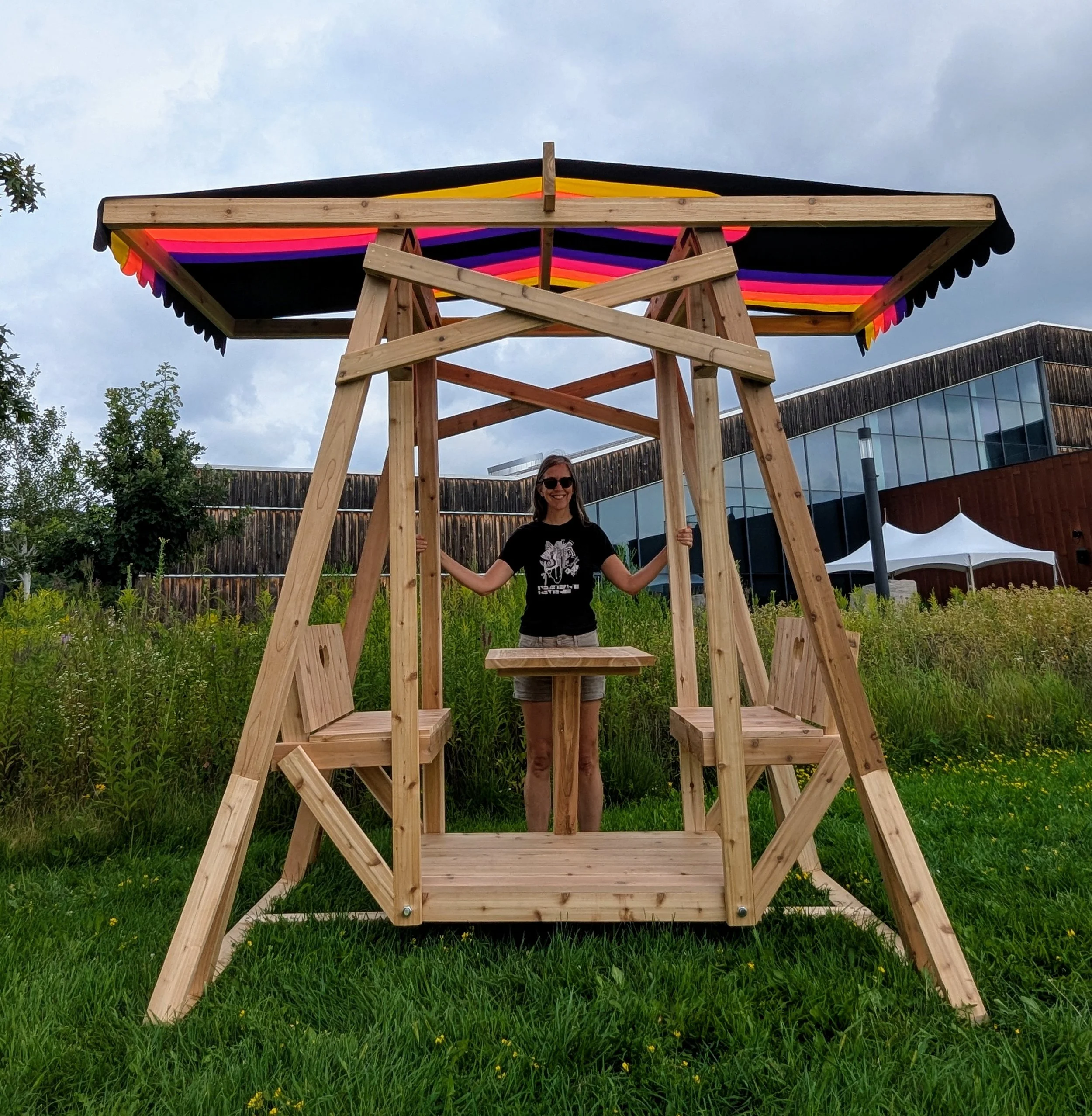
How it works: You and a partner will each ask each other a series of 20 questions - in person on the Face to Face swing, or through an online platform. You should allocate 60 minutes to the process, though previous participants have finished in less time.
Take turns introducing yourself, including your name and pronouns. Continue to take turns, asking your partner each of the 20 questions.
You ask a question and your partner answers; your partner then asks you the SAME question and you answer. Repeat using the
remaining 19 questions. Don’t jump around. Answer the questions sequentially, 1 to 20. Though some questions may be difficult - challenge yourself to stay in it, answering all of the questions to the best of your ability. This experiment is designed to not only help us share things about ourselves but also to listen, without comment, as someone shares with us. Make every attempt to listen with curiosity, minimizing distractions and interruptions.
Resist the urge to give feedback on your partner’s response or to ask additional questions about their answers. Allow them the space to simply share and be heard.
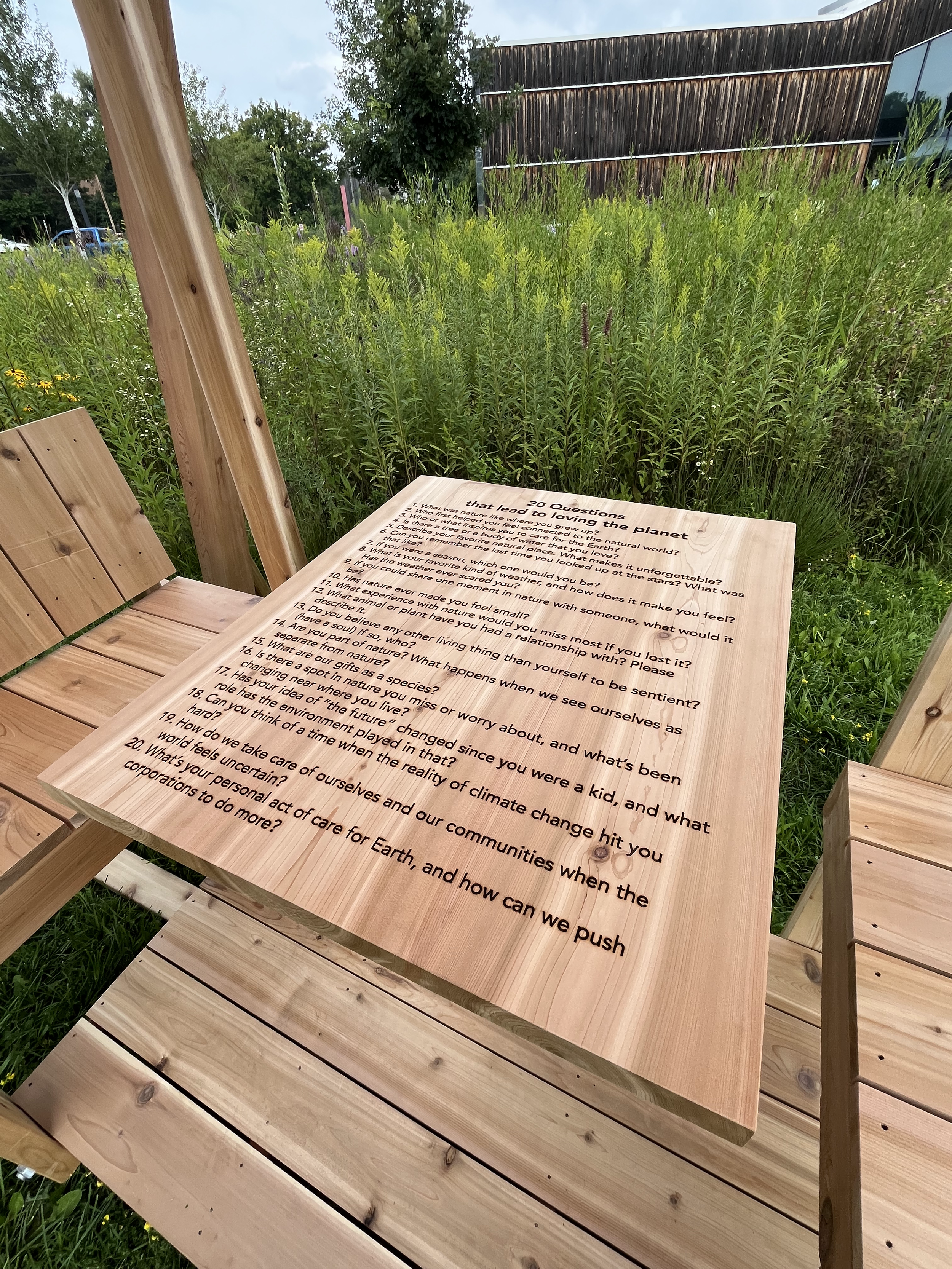
Goals or Outcomes Achieved:
Brought a dialogue about planetary love to a wider audience
What did you learn? Artistically? Administratively? About the community?
“With the questions formulated and swing constructed and installed in front of the Bell Museum, Alyssa got to see her collaborative creation in action! While resting in the museum’s Learning Landscape, she observed a couple approach the sculpture and read the instructions on the interpretive sign. She watched in surprised satisfaction as they took their seats on the swing across from one another and took turns asking each other the 20 questions.
This was the interaction Alyssa had envisioned for Face to Face, but even if participants choose not to follow the prompts, there is still value in the experience. The sculpture gives people the space to have a conversation or sit in quiet contemplation.
You don’t have to go to the Bell Museum to practice this exploration of planetary love; the collaborators created a toolkit that you can print, share, and explore on your own or with others.” (credit)
Links
Quote from the project:
Alyssa reflected on the collaborative process. “Early in my career, I tried to do everything myself.” But she learned over time that collaboration brought a richness to the work. “Collaborative work takes time,” she said, but it is worth it. “Each person brings their own insights and life experiences.” She described it as a small artistic ecosystem. “That’s how we make a strong community.” (credit)
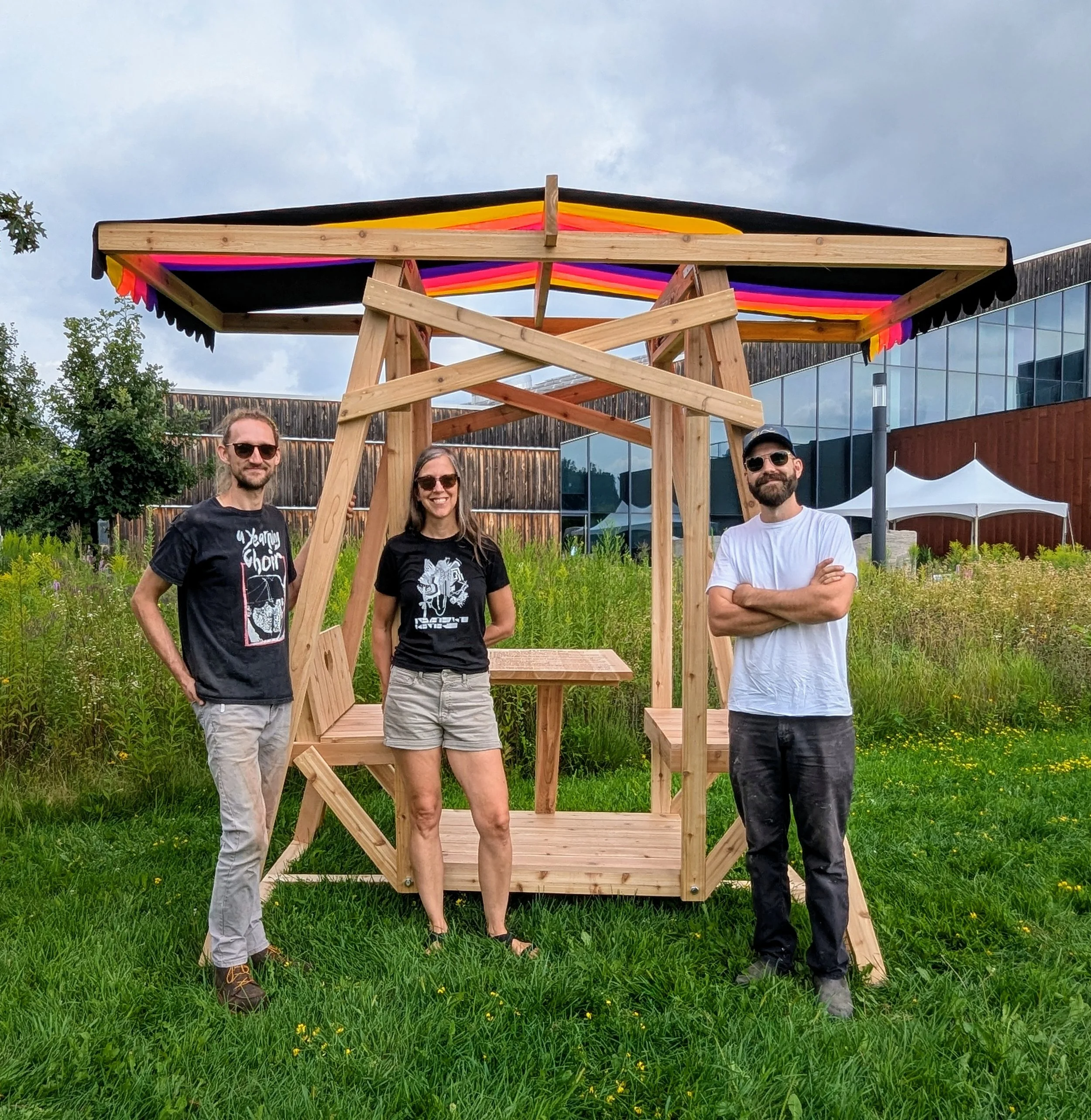
The Team:
Alyssa Baguss – Public artist and project lead. Alyssa creates interactive works that connect people to nature and one another.
Tom Bierlein & Ryan Justak of Potluck – Artists and builders specializing in human-centered design and functional sculpture.
Panelists: Alyssa Baguss, Rachel Dunlap, Emily Dzieweczynski, and Erin Sharkey - artists, educators, and environmental stewards who co-developed the 20-question final set.
